The Belgian construction sector is gradually entering a new phase. For a long time, when homeowners wanted to make their homes more sustainable, attention focused almost exclusively on energy consumption. The discussion centred on insulation, new windows, solar panels, heat pumps and more efficient ventilation systems.
These measures remain essential. But a second question is becoming increasingly important: what materials do we use to renovate our homes, where do they come from, and what will happen to them in twenty, thirty or fifty years?
This development explains the growing interest in circular and bio-based materials. It will be particularly visible at the next edition of Futurebuild Belgium, held on 11 and 12 March 2027 at Brussels Expo. The event will notably highlight circularity, innovation in materials, renovation, prefabrication and digital construction. A dedicated area, the Biobased Market, focuses on natural materials, bio-based insulation, timber construction and renewable resources.
For Belgian homeowners, these developments are no longer limited to experimental architecture. They are beginning to influence very practical decisions about roof insulation, façade renovation and the choice of materials during a complete energy renovation.
A sustainable home is no longer just about energy consumption
For several decades, the main objective of energy renovation was relatively simple: reduce the amount of energy needed to heat a home.
In a country such as Belgium, where a large proportion of the housing stock is relatively old, this priority remains entirely justified. A poorly insulated roof, uninsulated walls or outdated windows can cause significant heat loss.
But as a building becomes more efficient, the relative share of its environmental impact linked to materials increases.
Producing insulation, manufacturing bricks, processing timber, transporting materials to a site and replacing components at the end of their life all have an impact.
It is precisely to understand this aspect better that Belgium’s three Regions developed TOTEM, the Tool to Optimise the Total Environmental impact of Materials. This tool enables the Belgian construction sector to assess and reduce the environmental impact of buildings and their materials.
This approach encourages a much broader view of renovation.
The question is no longer only how much energy the home will use after the work. It is also about how many resources are needed to carry out the work and how long the installed materials can remain useful.
What is circular construction?
Circular construction is based on a relatively simple principle: a material should not become waste while it can still serve a useful purpose.
In a traditional renovation, some components are removed and immediately discarded. They are then replaced with new products.
In a circular approach, the first step is to examine what can be retained.
A timber structure can sometimes be reinforced rather than replaced. Bricks can be cleaned and reused. Some roof tiles can be recovered. Doors, finishing elements and technical components can also find a second use.
When direct reuse is not possible, recycling is another option.
OVAM, the Flemish waste agency, emphasises that the goal is to keep materials in their cycle for as long as possible. When materials are released during demolition or renovation, reuse should be considered before recycling. The organisation also stresses the importance of designing new buildings so that they can be dismantled more easily in the future.
For a homeowner, this philosophy may seem abstract, but it leads to a very practical question: do we really need to replace this component, or can it still be used?
Reuse is becoming a genuine renovation strategy
This development is also visible in Brussels.
Brussels Environment notably uses RENOLAB.B projects to explore reuse opportunities in real renovation projects. Training sessions were organised in 2026 around practices observed on these sites and the difficulties encountered when implementing them.
Reuse has an obvious environmental advantage: the product already exists.
Whenever a brick, beam or finishing element can remain in the building or be reused elsewhere, it may be possible to avoid manufacturing and transporting a new product.
That clearly does not mean everything should be kept.
A material may be damaged, contain undesirable substances or no longer meet current technical requirements. In an energy renovation, some existing elements may also prevent the desired performance from being achieved.
Circularity therefore does not mean preserving everything at any cost. It is about avoiding unnecessary replacement.
Bio-based materials are entering residential renovation
Alongside circular construction, bio-based materials are attracting increasing attention.
These are products made entirely or partly from renewable biological resources.
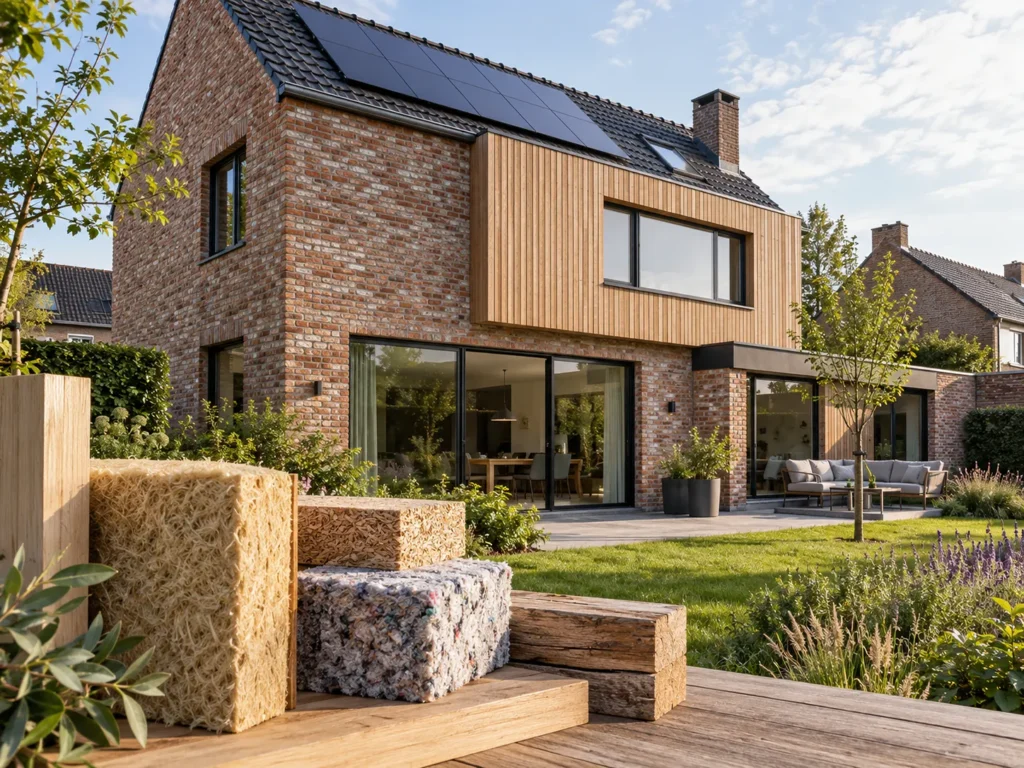
In insulation, examples include cellulose, wood fibre, hemp, cork, grass fibre, certain recycled textiles and straw.
Futurebuild Belgium now devotes a specific part of its event to this category of materials. Its Biobased Market brings together organisations working with natural insulation, timber and various renewable resources.
The exhibition also features several Belgian examples.
For example, IsoFabric produces insulation from recycled cotton collected in Belgium. The principle combines a material derived from a biological resource with the recovery and reuse of fibres.
This combination clearly illustrates the direction of the sector: the concepts of bio-based, recycled and circular materials are increasingly converging.
Why are homeowners interested in these insulation materials?
The origin of the material is obviously not its only benefit.
Residential insulation must first and foremost perform its function.
It must reduce heat loss, maintain its performance over time and be compatible with the construction of the roof or wall.
Some bio-based insulation materials also offer interesting properties in terms of moisture regulation or summer comfort.
Relatively dense materials can slow the movement of heat through a roof or wall. This can contribute to comfort during hot periods, particularly in bedrooms beneath the roof.
But the effect always depends on the complete construction build-up.
The thickness of the insulation, interior finishes, exterior materials, airtightness, building orientation and solar shading also play a role.
It would therefore be incorrect to present bio-based materials as a miracle solution.
Bio-based does not automatically mean better
The word “natural” can be appealing in construction marketing.
However, a material must always be assessed on its actual performance.
Buildwise notes, for example, that for the acoustics of framed walls, whether insulation is bio-based is not in itself the decisive factor. Flexible materials such as wood fibre, cellulose, grass, textiles or sheep’s wool can achieve performance comparable to mineral wool. Final performance also depends on the studs, boards, cavity width and junctions.
The same principle applies to thermal performance and moisture management.
Insulation that looks excellent on paper can become problematic when it is installed poorly.
In a roof, for example, poor airtightness can allow humid indoor air to enter the construction. When that air reaches a cold area, condensation can form.
The choice of insulation must therefore always be accompanied by correct design of the entire roof or wall assembly.
A renovation should be designed as a system
This shift towards more sustainable materials is part of another change in the market: renovations are becoming more comprehensive.
A few years ago, many homeowners carried out work step by step without necessarily establishing an overall strategy.
Windows might be replaced one year, the boiler a few years later, and the roof perhaps insulated after that.
This approach may still be necessary for budget reasons, but better coordination can avoid certain mistakes.
A heat pump, for example, works best in a home whose heating demand has already been reduced sufficiently.
New insulation can alter the building’s moisture behaviour.
New, more airtight windows can make proper ventilation even more important.
Energy choices and materials therefore need to be considered together.
Digitalisation could simplify complex renovations
Futurebuild Belgium also places a strong emphasis on digital construction, retrofit and prefabricated solutions. The exhibition lists dozens of companies in categories related to digital construction, material innovation and circularity.
In the residential sector, digitalisation can make renovation planning easier.
An accurate survey of the building can be used to create a digital model of the home. The dimensions of walls, openings and the roof can then be used to prepare certain components in a workshop.
In some renovation approaches, façade modules or prefabricated insulation elements can therefore be produced before they arrive on site.
The potential benefit is significant: reducing time spent working on site, limiting errors and improving coordination between the different trades.
For homeowners who continue living in their property during renovation, reducing the duration of the works can be a considerable advantage.
Designing a home so it can be modified later
Circularity is not only about materials recovered today.
It also changes the way new elements should be installed.
A material that is permanently bonded to several other layers can be extremely difficult to separate.
During a future renovation, the entire system may then have to be destroyed even if some components are still usable.
Mechanical fastening can sometimes allow much cleaner disassembly.
This thinking about reversibility also appears in Belgian training programmes on circular construction. Brussels Environment programmes notably address material recovery as well as spatial and technical reversibility.
The aim is to create buildings that can evolve.
A family may need to rearrange rooms. A technical installation may need replacing. A façade may need renovation several decades after construction.
When these adaptations are anticipated, they can require less demolition and fewer new materials.
Embodied carbon is becoming increasingly important
When a building uses a great deal of energy for heating, the environmental impact of that consumption often dominates its overall footprint.
But as homes become more efficient, material production represents a proportionally larger share of their total impact.
This is often referred to as embodied carbon.
It corresponds to emissions associated with extracting raw materials, manufacturing, transport, construction, maintenance and potentially the end of the materials’ life.
It is precisely to avoid shifting the problem elsewhere that tools such as TOTEM use a life-cycle approach.
A material may, for example, perform very well environmentally during use but require a great deal of energy to manufacture.
Conversely, reusing an existing component can avoid much of this new production.
Local sourcing can also play a role
Belgium has a relatively compact territory and a dense network of companies specialised in construction.
This creates opportunities to develop more local material supply chains.
Insulation made from resources recovered in Belgium can reduce some transport while retaining economic value within the country.
IsoFabric, which uses recycled cotton collected in Belgium, is an example of this approach.
Environmental claims nevertheless need to be treated with caution.
A local product is not automatically better than an imported product.
Its impact depends on how it is manufactured, its lifespan, its performance, transport distances and what happens to it at the end of its life.
That is why a complete assessment remains more relevant than a simple “local” or “natural” label.
What does this change for a roof renovation?
The roof is probably one of the places where homeowners will encounter these new materials most quickly.
When a roof needs renovating, different families of insulation materials can be considered.
The choice will depend on the available space, existing structure, required thickness, moisture behaviour, desired summer comfort and budget.
It is also the right time to examine the condition of the roof structure.
In a circular approach, an existing structure in good condition will be retained whenever it is technically appropriate.
The renovation can then be coordinated with airtightness, home ventilation and, where relevant, the installation of solar panels.
This combination avoids unnecessarily reopening the roof a few years later.
What about façade renovation?
The same logic applies to external walls.
Before choosing insulation, it is important to understand the construction and condition of the existing wall.
A brick façade in good condition can sometimes be retained while insulation is installed internally or in an existing cavity.
In other cases, external insulation will be more suitable.
If a façade nevertheless has to be dismantled, it may be worth examining whether some materials can be recovered.
The possibilities vary enormously depending on the type of construction, the fixings used and the condition of the materials.
This is precisely why circularity should ideally be considered at the start of the project rather than when the waste reaches a skip.
Futurebuild Belgium 2027 shows the direction the market is taking
Futurebuild Belgium will take place on 11 and 12 March 2027 at Brussels Expo, Hall 11. The event brings together the construction and property value chain around innovation and the transition towards a climate-neutral built environment.
The presence of categories dedicated to circularity, material innovation, retrofit, digital construction and prefabrication mainly shows that these subjects are beginning to converge.
The future of renovation will probably not be based on one revolutionary technology.
It will rely more on combining several improvements.
A better-insulated building envelope, an efficient heating system, renewable electricity generation, proper ventilation and materials selected according to their life cycle can together create a much more sustainable home.
A new definition of sustainable renovation
For Belgian homeowners, perhaps the main change is this: a sustainable renovation is no longer measured only by the number of kilowatt-hours saved.
Energy performance remains fundamental, particularly for reducing bills and preparing the home for future energy requirements.
But the choice of materials adds a second dimension.
Can some of what already exists be retained?
Does the new material use resources efficiently?
Can it last for several decades?
Can it be repaired or replaced without demolishing the entire system?
And is there a technically equivalent solution with a lower environmental impact?
These questions should gradually become as normal as comparing insulation values.
Summary
Circular and bio-based materials are taking an increasingly visible place in the Belgian construction sector.
Circular construction first seeks to extend the life of existing materials through preservation, reuse and design for disassembly. Bio-based materials, meanwhile, use renewable biological resources such as wood, cellulose, grass or certain textile fibres.
These solutions can be particularly attractive for insulating roofs and walls, but their origin alone never guarantees their performance.
A good renovation must always consider the building as a whole, including insulation, airtightness, ventilation, moisture and energy systems.
Belgian tools such as TOTEM now make it possible to incorporate the environmental impact of materials more precisely into construction decisions.
Futurebuild Belgium 2027 should further increase the visibility of these solutions and show how circularity, bio-based materials, prefabrication and energy renovation are beginning to converge.
For a homeowner, the aim is not to seek at all costs the material presented as the most environmentally friendly. It is rather to choose a durable solution that is technically suited to the building and coherent with the renovation project as a whole.